Vitamin Enriched Casting Blog
Vitamin Enriched Casting Blog
September 25, 2026 • Real People Casting
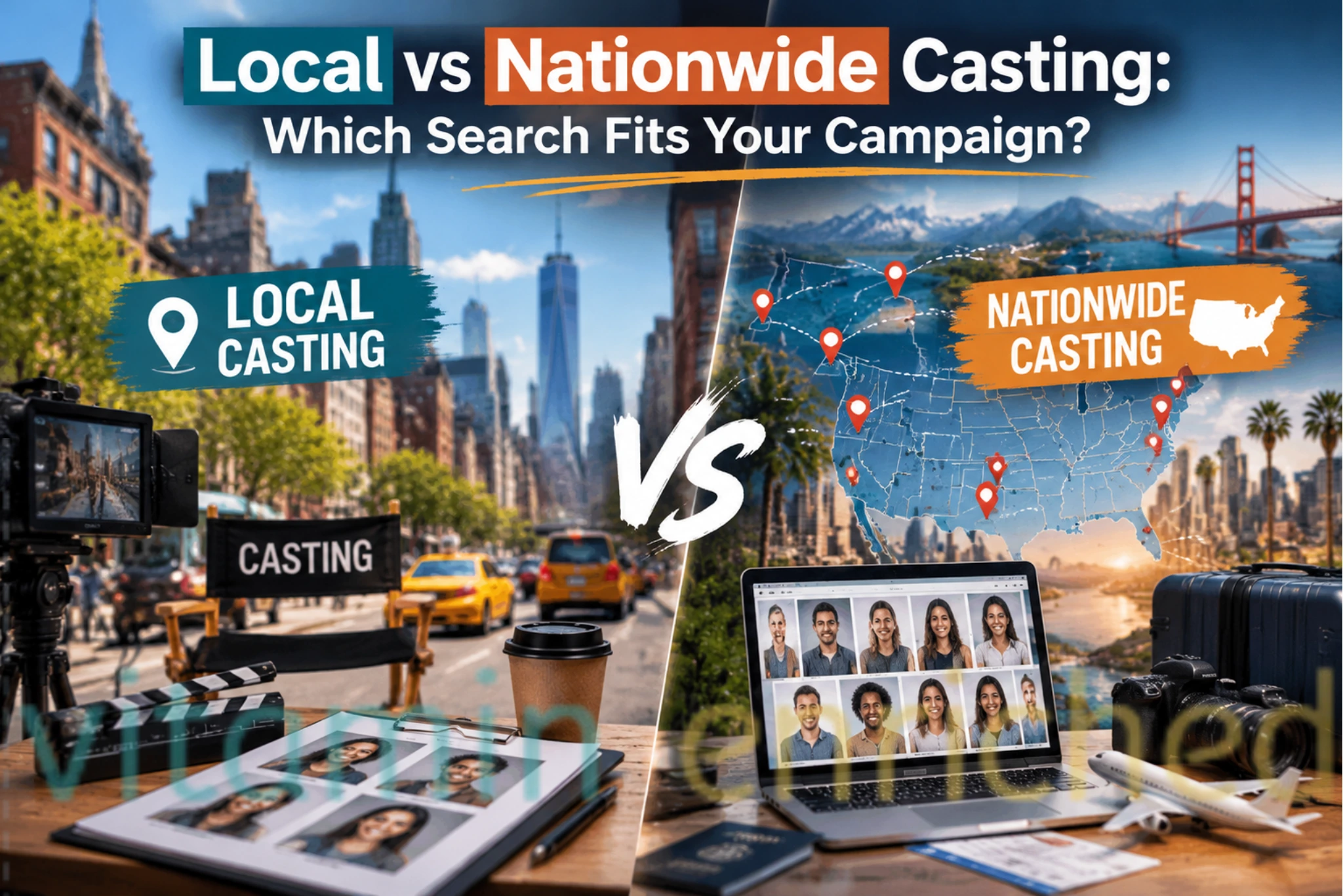
Local vs nationwide casting is really a question of search radius: should a casting team concentrate on one city or region, or open the research across multiple U.S. markets? The right answer depends on the brief, the type of person the project needs, where production is happening, how rare the criteria are, and what travel or scheduling constraints exist.
A local search can be efficient when location is part of the story or when the right people are likely to be found near the shoot. A nationwide casting search can be more useful when the brief is highly specific and the best candidate could be anywhere in the country. Neither approach is automatically better. The goal is to use the smallest realistic search area that still gives the project a strong chance of finding the right people.
Vitamin Enriched works in New York and across the U.S. Its
real people casting
is built around research, outreach, screening, and real stories, so the geographic scope can be shaped around what the project actually requires.
Local casting limits the search to a defined city, metro area, or region. For a New York production, that may mean New York City, the tri-state area, or a specific set of neighborhoods and communities.
For projects that need
real people casting in New York,
the research can focus on local organizations, businesses, professional networks, community groups, street-level outreach, referrals, and people who can realistically attend callbacks, fittings, or shoot days nearby.
Local casting is especially useful when the location itself matters. A campaign may want people who genuinely live in a place, understand its culture, or represent a recognizable local community.
Vitamin Enriched, for example, publicly searched for
real New Yorkers ages 16 to 80
for a sports-brand commercial designed around contemporary New York streets and communities.
Nationwide casting expands the research across multiple states or the entire U.S. It is useful when the participant criteria are more important than proximity.
The brief may call for a rare profession, a specific medical experience, an unusual family relationship, a real product customer, a specialized skill, or a very particular life story.
A national casting search does not simply mean posting the same open call everywhere. Strong nationwide searches still need targeted research, relevant outreach, remote screening, consistent shortlisting, and clear logistics.
Vitamin Enriched has publicly described nationwide searches for highly specific participants, including
young people living with rare visible diseases
and
children using eye-gaze technology to make music
.
Start with the production reality. If the shoot is in New York and the brief is broad enough that qualified people are likely to be found nearby, a local search may be more efficient.
If the project needs someone with a rare background or specific real-world experience, limiting the search too early can shrink the pool before research has a fair chance to work.
The search radius can also sit between the two extremes. Some projects may need a few priority markets rather than one city or the entire country.
The important decision is not whether the search sounds local or national; it is whether the geography gives the casting team access to a large enough qualified pool without creating unnecessary logistics.
The more specific the brief, the more valuable a wider search can become. A request for “parents in New York” may have a large local pool. A request for “a parent and child with a specific shared skill, life experience, or product relationship” may require a broader research map.
Before expanding geography, separate the brief into true must-haves and nice-to-haves.
If every preference is treated as mandatory, even a nationwide search can become unnecessarily difficult. If the team knows which requirements are essential and which can flex, it can choose the search radius more intelligently.
| Factor | Local Casting | Nationwide Casting |
|---|---|---|
| Reach | One city, metro area, or region | Multiple cities, states, or the entire U.S. |
| Pool size | Smaller but often easier to manage | Larger and useful for rare or highly specific criteria |
| Research | Neighborhoods, local groups, businesses, organizations, and referrals | National and regional organizations, online communities, referrals, and market-by-market outreach |
| Remote screening | Useful, but in-person options may be practical | Usually central to early screening and callbacks |
| Travel / logistics | Simpler when participants are already near production | Travel, shoot city, fittings, and availability need earlier planning |
| Best fit | Location matters or the local pool is likely to be strong | The criteria are rare, multi-market, or not tied to one location |
Remote screening is useful in both local and nationwide casting, but it becomes especially important when candidates are spread across different markets.
Self-recorded submissions and live video conversations allow the casting team to verify the core criteria, understand the participant’s story, and see how comfortably they communicate before travel or in-person callbacks are discussed.
A local search may still use remote screening for convenience, then bring selected candidates into an in-person callback if the project requires it.
In a nationwide search, remote screening helps keep the process consistent across geography and prevents unnecessary travel during the early stages.
Logistics can be the deciding factor. A nationwide search may uncover an excellent participant, but the production still has to determine whether that person can realistically be booked.
Producers should clarify shoot location, travel coverage, fitting dates, callback format, work eligibility, guardian requirements for minors, and any schedule restrictions before the search gets too far.
Local casting can reduce travel complexity, but it should not be chosen only to make logistics easier if the local pool is unlikely to satisfy the brief.
The better approach is to balance search quality with production reality.
A local search is not always faster, and a nationwide search is not always slower. Timeline depends more on the difficulty of the brief than on geography alone.
A highly specific local search can take substantial research, while a broader national search may move quickly if the target community is easy to identify and responsive.
The biggest timeline risks are usually unclear criteria, late changes to the brief, slow client feedback, hard-to-reach communities, verification requirements, and travel decisions that are left until the end.
Locking the must-haves early helps both local and nationwide searches move more efficiently.
For producers, the simplest way to choose between local and nationwide casting is to ask what the story actually requires.
Start local when place matters, the criteria are common enough, and the production benefits from nearby participants. Expand nationally when the criteria are rare, the campaign wants stories from multiple regions, or the right person could realistically be anywhere in the U.S.
Vitamin Enriched’s public casting archive shows both approaches in practice.
For a
New York sports-brand commercial
,
the team specifically sought authentic New Yorkers whose backgrounds and styles reflected the city. That is a location-led search where local identity was central to the creative.
For other projects, VE has searched nationwide when the participant requirements were more specialized.
The
Montefiore Einstein project
required young people with rare visible diseases, while the
eye-gaze music campaign
searched across the U.S. for children with motor disabilities who used eye-gaze technology.
In both cases, widening geography supported a highly specific brief rather than simply increasing volume.
No. The right scope depends on the brief, participant criteria, production location, timeline, and logistics. A local search can be the strongest choice when geography matters and the local pool is sufficient.
Expansion makes sense when the local pool is too limited, the participant criteria are rare, or the campaign needs people from multiple regions.
Yes. Remote submissions and video callbacks can make a local process more efficient even when the final shoot or callback is in person.
It can. Travel depends on where the selected participant lives and where production takes place, so the brief should clarify travel expectations early.
Define the must-have participant criteria, shoot location, dates, travel parameters, callback format, and which parts of the brief can flex.